

In an era where images are born from bits and transmitted instantly, I choose to slow them down. “Print Error” is a collection about the encounter between digital language and the painterly gesture, about how precise, calculated lines can be recreated — or freely reimagined — with the imperfection and vibration of the hand.
I have borrowed and modified aesthetics that belong to the virtual world: iconic images, cascades of code, glitches, printer patterns, toner smudges — and transformed them into tactile objects, with textures and layers of color. Here, the “error” is not a flaw, but the moment when the imaginary algorithm halts and makes room for human unpredictability.
“Print Error” is a serious joke: it both imitates and betrays what the world considers mechanically perfect, producing drips, streaks, vibrations. It is a reminder that, no matter how far technology advances, the human signature — imperfect, personal, alive — remains unique by its very nature.

Analogue Moonwalk, 2025
(100x70cm, acrylic on canvas)
I showed a friend “Monochrome Beats” and he told me I draw “digitally,” that my lines look like those traced by a printer after a stream of bits (thanks, Mile!). I took that as a challenge.
I borrowed the green code cascades from the Matrix aesthetic and “printed” in their midst an iconic silhouette, caught in its famous levitation. Only here, I made the “digital” analogue — from patches of color laid down by hand.
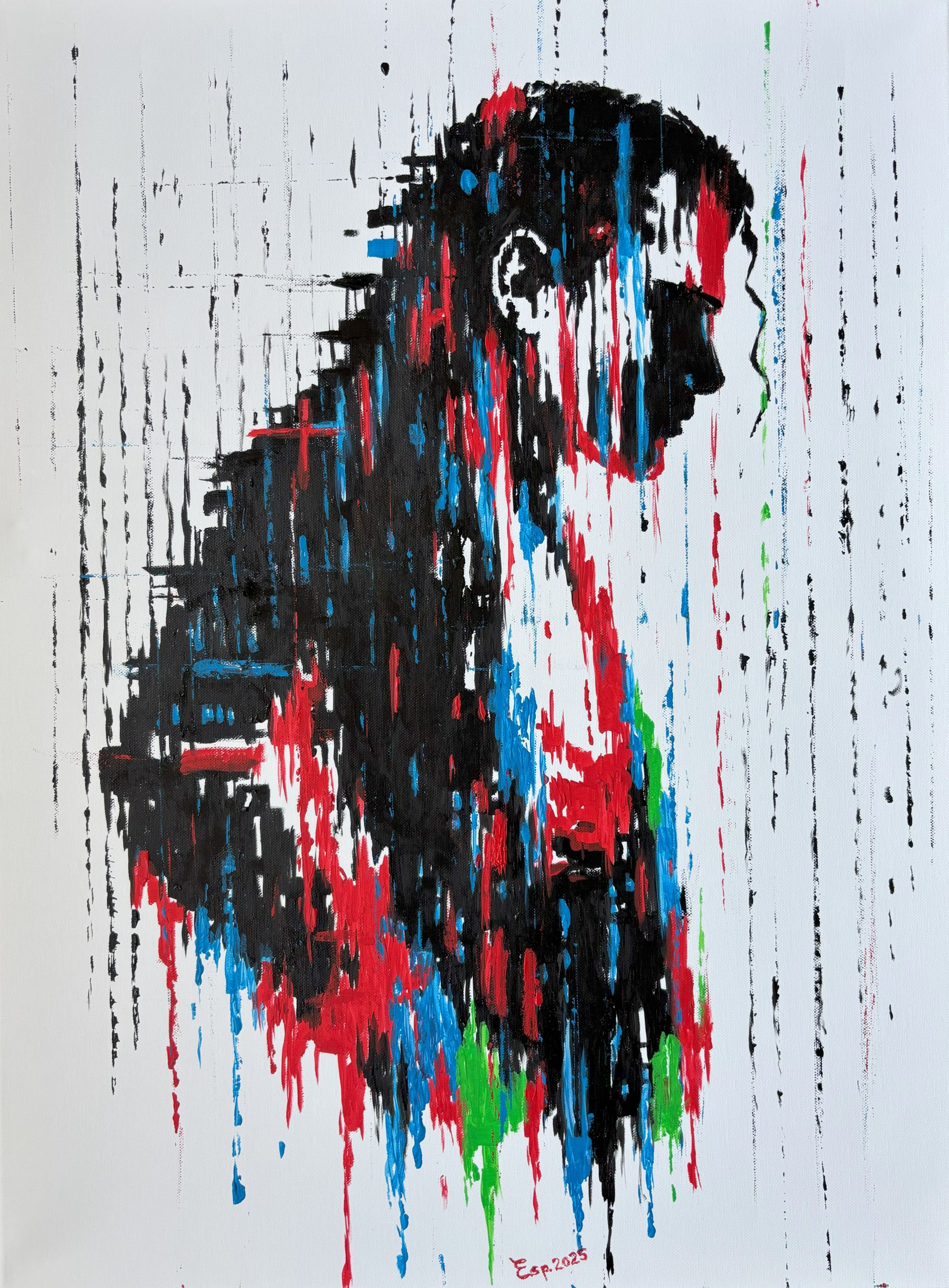
RGB, 2025
(80x60cm, acrylic on canvas)
RGB is also part of the Print Error collection, the one about the encounter between digital language and the painterly gesture. I let the colors flow in vertical streams, like data rewriting itself in real time, and in the middle, from their interference, a famous silhouette took shape.
But here, unlike a monitor that displays everything through combinations of red-green-blue, each “pixel” is a patch of color laid down by hand, with imperfections and vibrations that make the “digital” come alive.
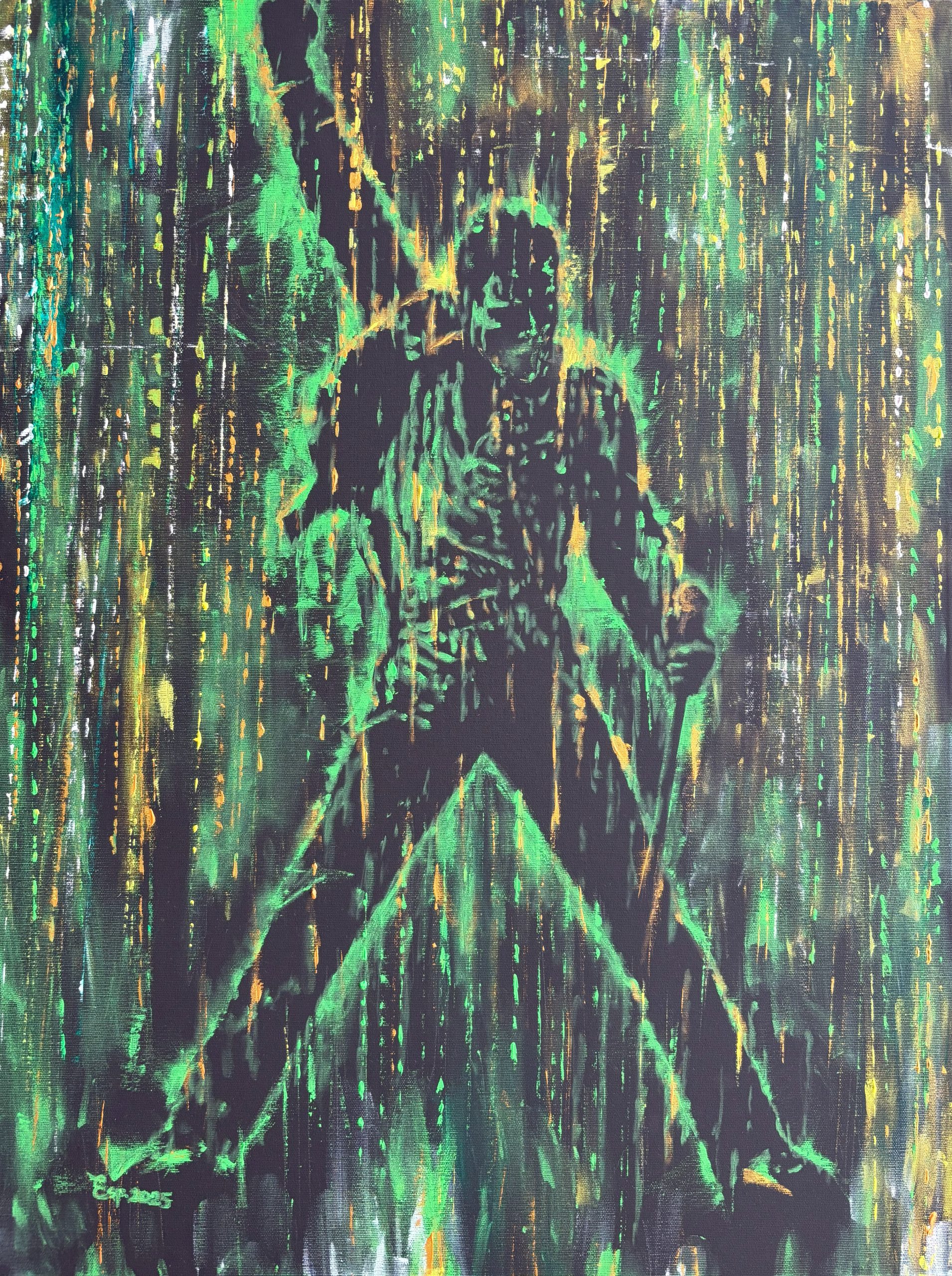
Golden Rain, 2025
(80x60cm, acrylic on canvas)
Golden Rain is also part of my Print Error collection, where the painterly gesture replaces the cold lines of the digital.
The silhouette is not drawn with mechanical precision, but emerges from drips and vibrations, from imperfect traces which, seen up close, seem chaotic, yet from a distance gather into an iconic image.
Here, it’s not the bit that matters, nor the isolated mark, but the final impression — that moment when “error” becomes expression. The title alludes to another famous rain and another rock singer, but Golden Rain speaks of the beauty of imperfection and of the way the analogue can rewrite the digital.
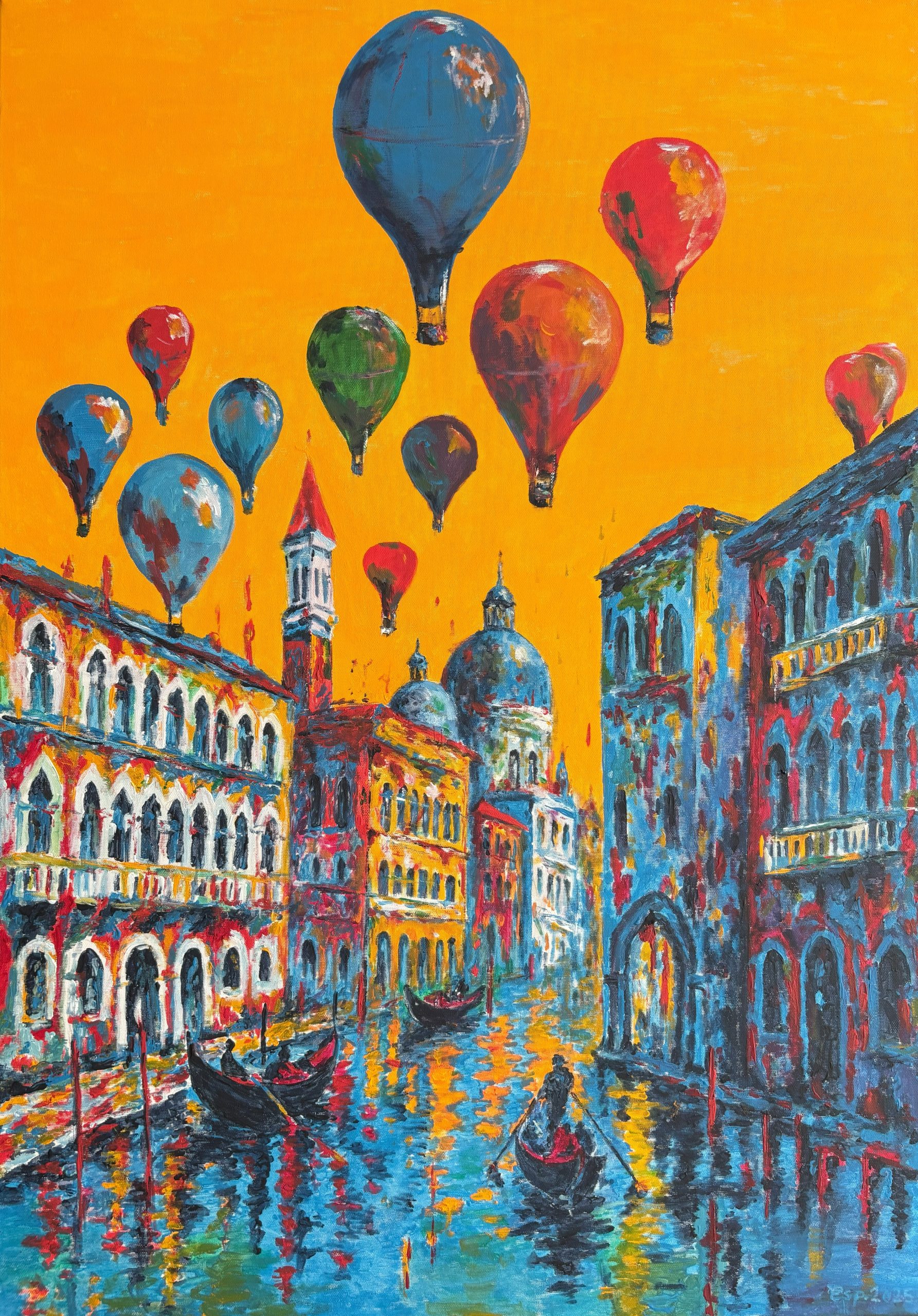
Venezia con Te, 2025
(100x70cm, acrylic on canvas)
I’ve told you before that I listen to music while I paint. Not always, and usually I choose a style and let the app suggest a playlist.
A few months ago I discovered the Spanish version of a Charles Aznavour album, which included the song “Venecia sin ti.” If in that song I felt the melancholy of absence, what I wanted to capture was exactly the opposite.
For me, “Venezia con te” represents the joy of presence, and of colors igniting together. I brought in hot-air balloons (or are they light bulbs?), not typical of Venice but more of Cappadocia — like a personal dream: I would love to see the city floating from above, with the same lightness with which desires rise toward the sky.
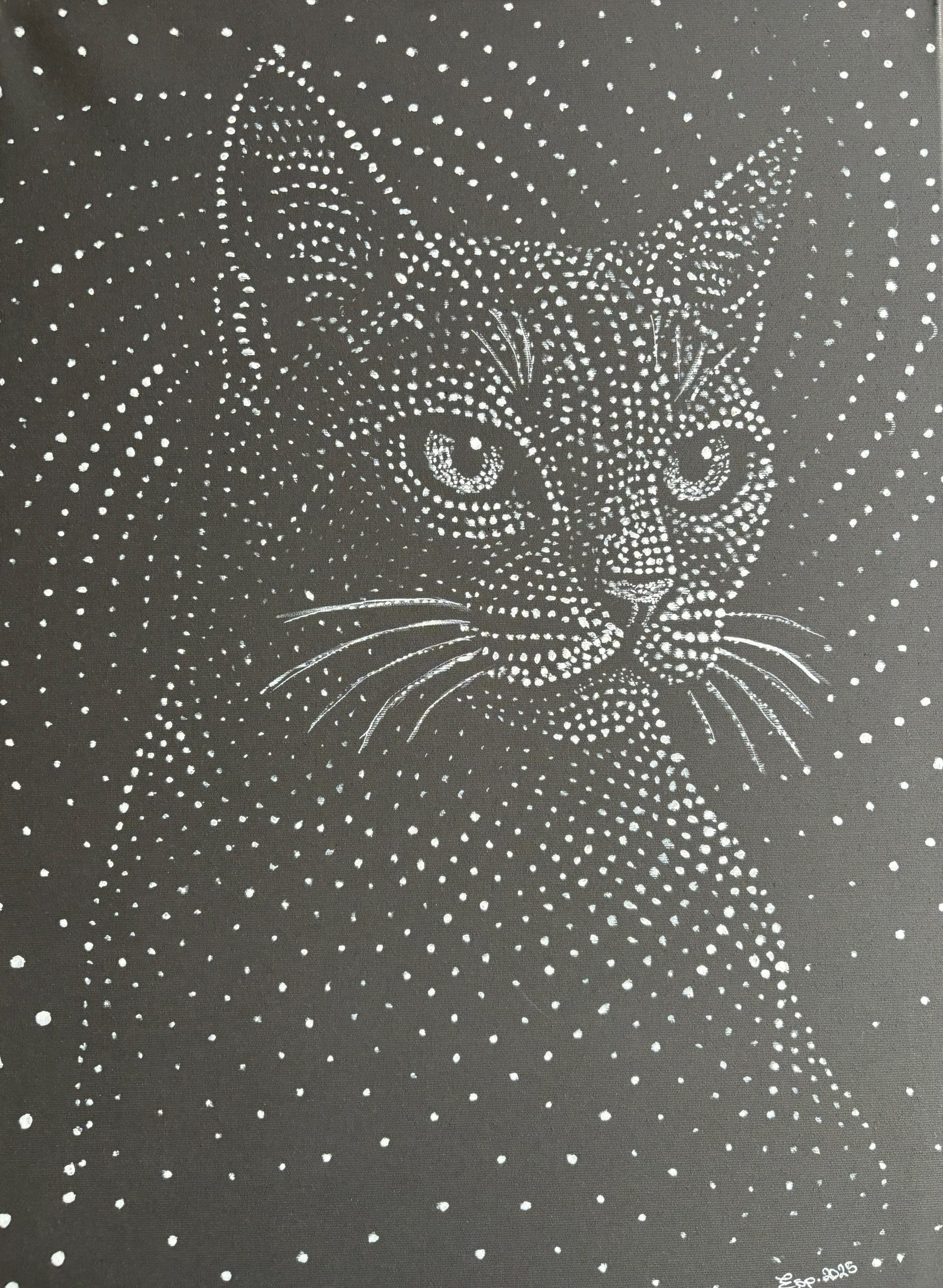
The White Cat, 2025
(70x50cm, acrylic on canvas)
I was thinking about how animals — especially cats — manage to be invisible presences and, at the same time, so powerful. They enter a room and somehow the space changes. It’s a quiet kind of magic.
And since duality plays a central role in many of my works, the cat took shape out of small dots, like a constellation gathered on the canvas.
Just as, taken separately, the dots carry no particular meaning and seem almost banal, but together they create sense and form — so too do their subtle, almost invisible gestures change our world without us even realizing it. And, as part of Print Error, I made the dots unequal, imperfect.
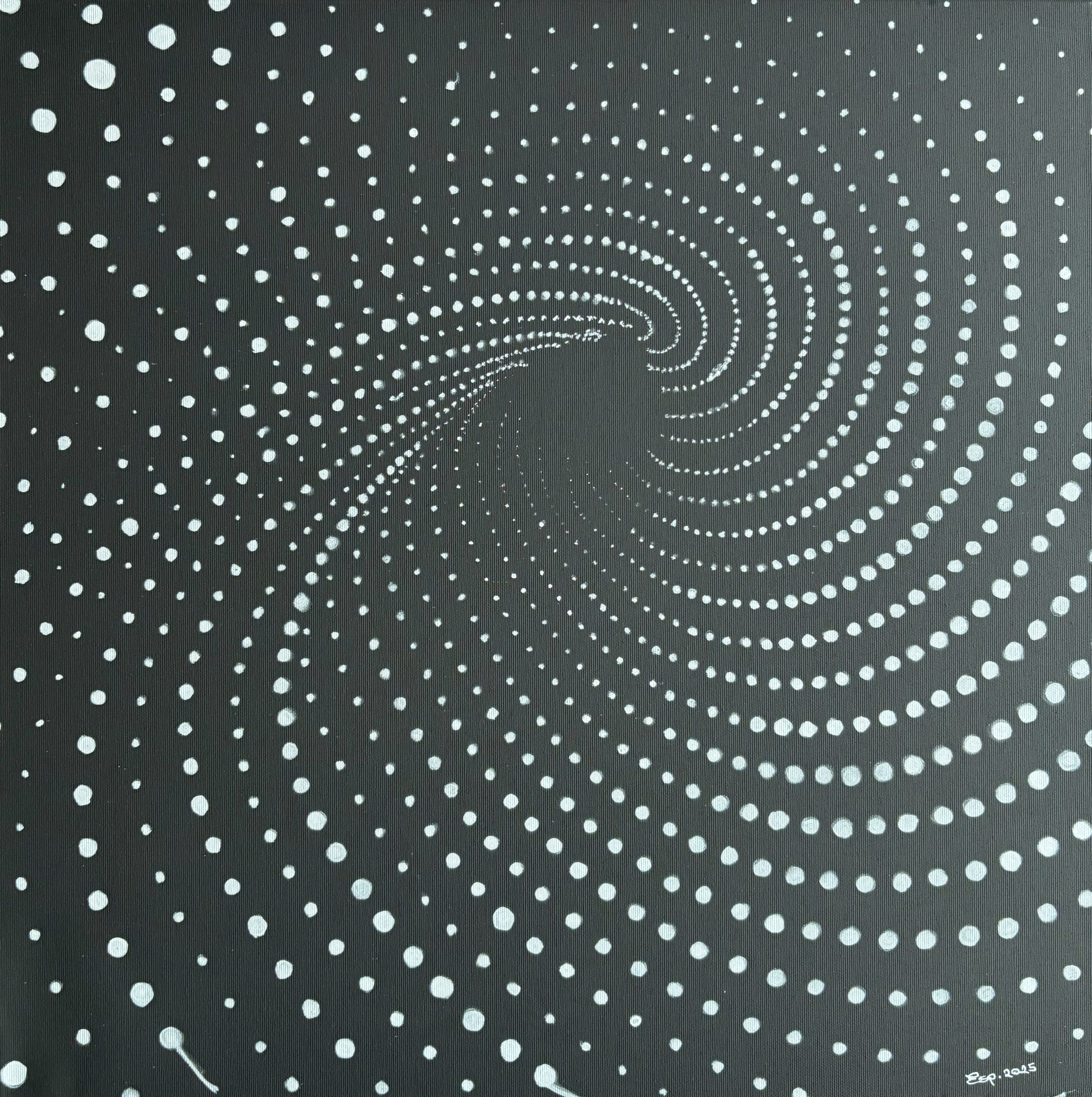
Vortex, 2025
(60x60cm, acrylic on canvas)
The universe remains, for the most part, unknown to us, and vortices and black holes are gateways that fascinate precisely through their mystery: we don’t know what lies beyond. I tried to capture that attraction, that hypnotic spiral of the unknown.
The dots are not perfect, nor do I intend them to be. In the spirit of the Print Error collection, they borrow digital aesthetics and translate them into my own style. From this imperfection a visual order emerges — an imaginary algorithm that fractures and makes room for the human, becoming a reflection on how imperfection generates meaning, and how the unknown draws us in not through answers, but through the questions it opens.
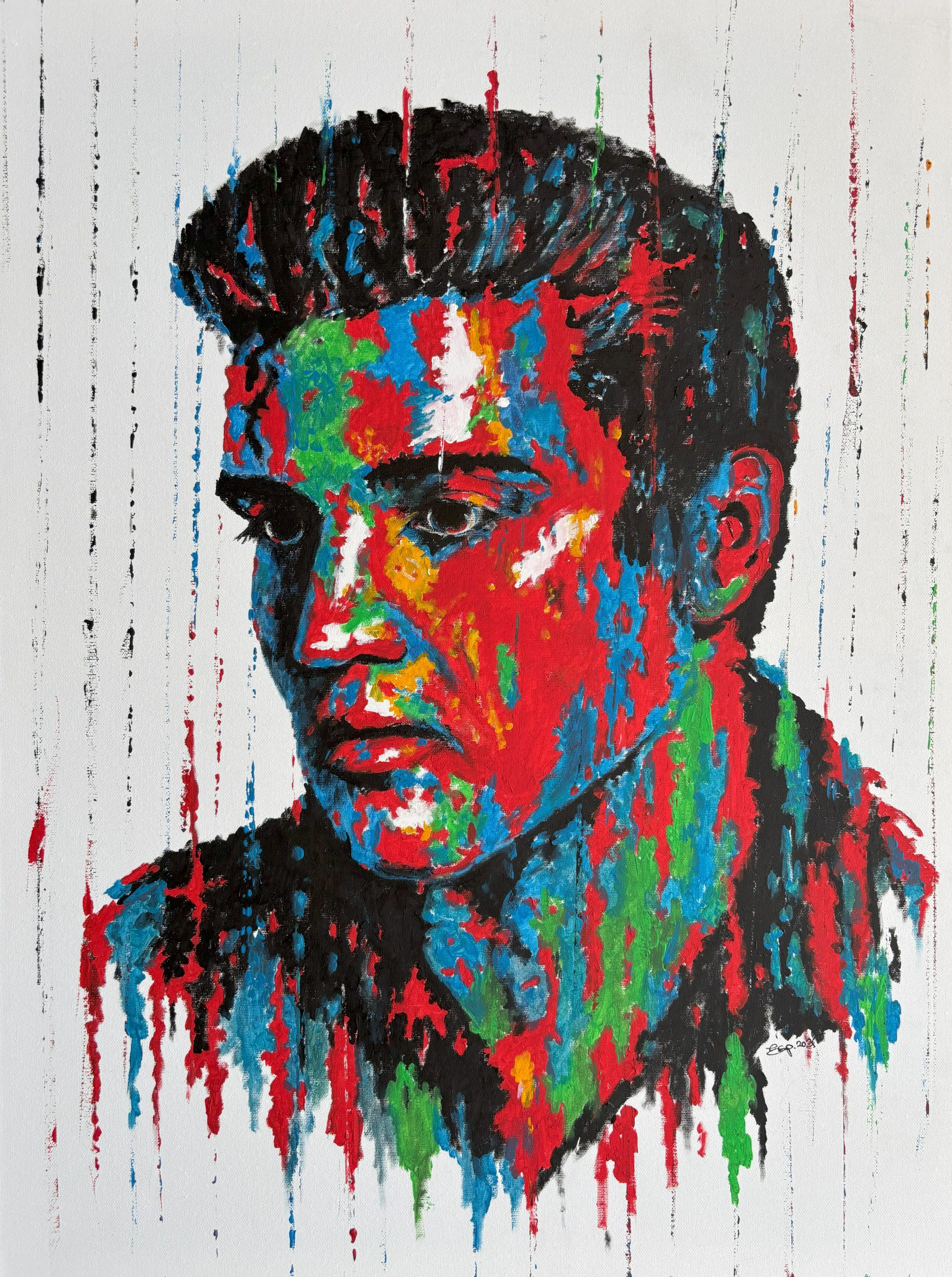
The King, 2025 (SOLD)
(80x60cm, acrylic on canvas)
In visual culture, the image of the “king” is among the most recognizable. But, as I do in Print Error, what seems familiar is transformed once it passes through the filter of the painterly gesture.
The portrait is not rendered photographically, but fragmented — like a glitch that simultaneously unravels and recomposes the figure. Colors intersect, drip, and invite the gaze to search for the face beyond appearances. Error becomes a tool: a reminder that even within the most “iconic” images, there is room for vibration, imperfection, and reinterpretation.
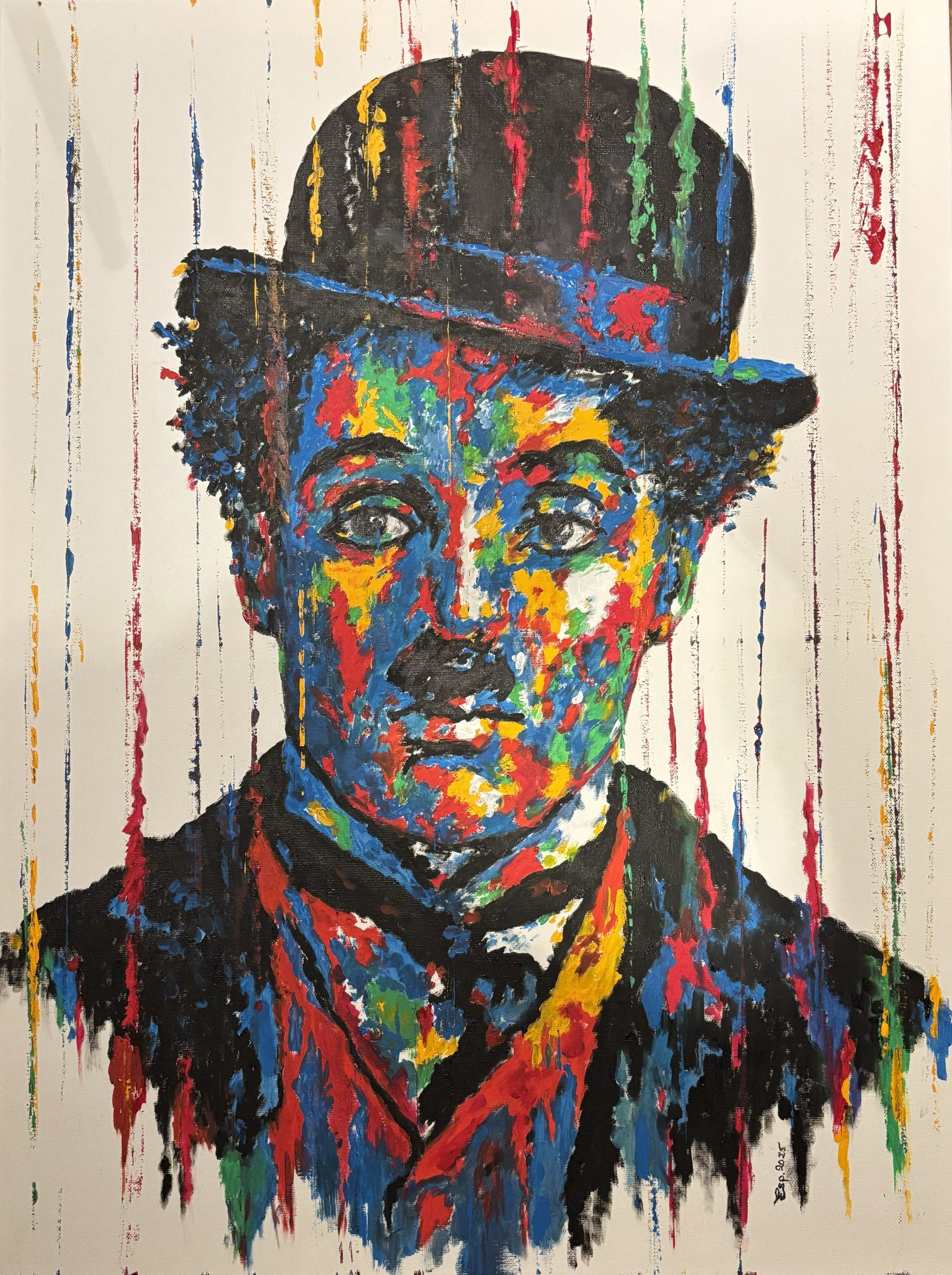
Error 404: System Too Human, 2025 (SOLD)
(80x60cm, acrylic on canvas)
In the logic of machines, an excess of humanity appears as an error. Here, the face of a legend fractures along the faulty lines that define my Print Error series — born from an empathy that exceeds the frame. Laughter becomes a signal, color becomes code, and the figure recomposes itself from fragments, echoing between memory and glitch. A symbol of candor and clarity, he reappears as a bridge between eras, between humor and melancholy, between humanity and fragility. Before the algorithm, he remains irredeemably human — a “bug” of tenderness within a system striving for perfection.